Ney Lessons
Ney Lessons - 15 -
Music Terms and Vibration
We complete Ney lessons as 15th and final lessons.
After that, we will update our courses in the direction of your requests.
In this lesson, we will refer to the music terms we care about and the nuance signs we care about.
Rank: A measure of the rhythm of a piece of music according to various units.
The rank is referred to in the western music, such as Allegro, Moderato, Presto.
It is used with names such as 1.Mertebe, 2.Mertebe in Turkish Music.
aCapella: Oral works without an instrument or orchestra.
We find examples especially in mystic music and mosque and church music.
N�ans (Dynamics): It normally refers to the volume of a sound or note,
but can also refer to every aspect of the execution of a given piece, either stylistic (staccato, legato etc.)
or functional (velocity).
The term is also applied to the written or printed musical notation used to indicate dynamics.
Now let's recognize the important signs of nuance:

Video:
Sample:

Video:

For example;
Soon.
Ba� : It is a sign of combining two or more nobles without breathing between them.
We do not breathe while playing these notes.
Aşağıdaki portelerde bağ işareti örneklerini görmektesiniz.

Slowly:
Normal tempo:
Sample:
The notes in the first dimension are expressed with the tongue,
while the bound notes in the 2nd dimension are expressed without collision and straight:

Video:
Piano : It means "soft" and its sign is "p".
Pianosimo : It means "very soft" and its sign is "pp".
Pianississimo : It means "veryvery soft" and its sign is "ppp".

Video:
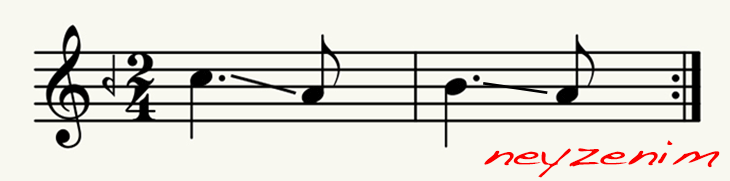
Glissando : In piano or stringed instruments,
is to slide the fingers on the keys or wire.
You can see the glissando sign example in the portals below:
Video:
Forte: It is a nuance term that indicates that the loudness should be high in performance ”.
Fortissimo: It is shown as “gerektiğini”, which is a nuance that indicates that the loudness should be higher.
Fortississimo: It is shown as “ƒƒƒ”, a nuance that indicates that the loudness should be very high.
You can see the forte varieties in the portal below.

Video:
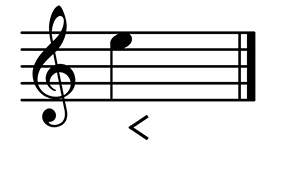
It indicates to play with increasing strength and is shown as <.
Video:
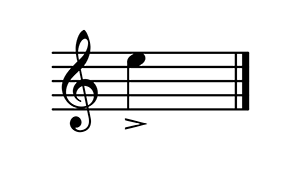
Decrescendo: It indicates gradually decreasing volume and is shown as >.
Video:
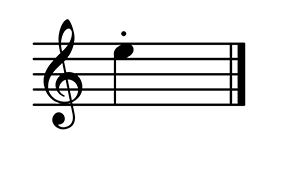
Stacatto : Each of the notes one by one
indicates that
it will be played without being connectedve
and " . "indicated by a dot.
Aşağıdaki portede nokta işaretini görmektesiniz :
Videomuz:
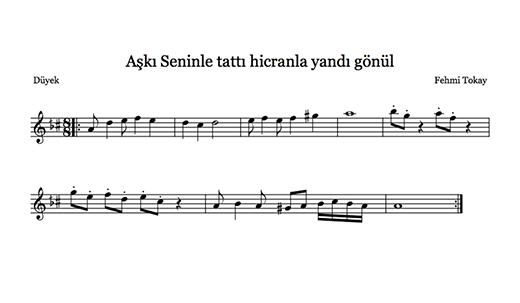
You can enlarge by clicking the note.
Video:
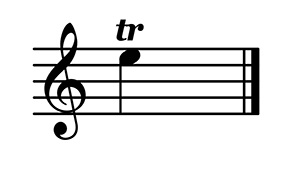
Trille ( Tril ) : with tr
is displayed, it is read in conjunction with the note after the written note.
trill:
Video :
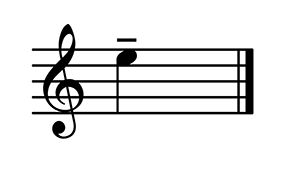
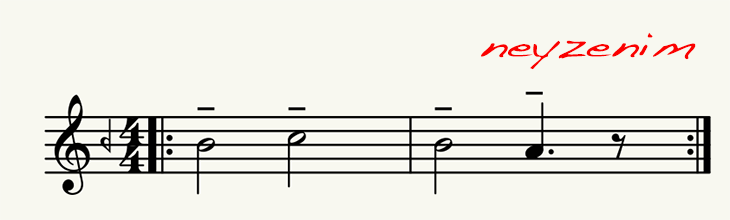
Legato : There is no sound between them
is a sign that requires them to follow each other without interruption.
" - "
Like this.
In the following portrait you see the legato sign:
Video :
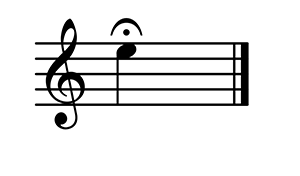
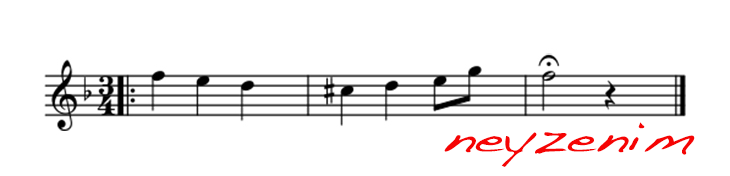
Puandorg : It is a sign to lengthen the notes as much as we want freely, regardless of rhythm.
You can see the puandorg sign in the portal below :
Video :
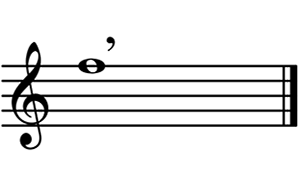
Sign of breath : we'll breathe in a song
is the sign indicating the place.
( ’ ) this figure is shown.
Video:
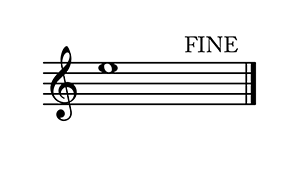
Fin : Shows the end of the song
" Fine "
Sample:
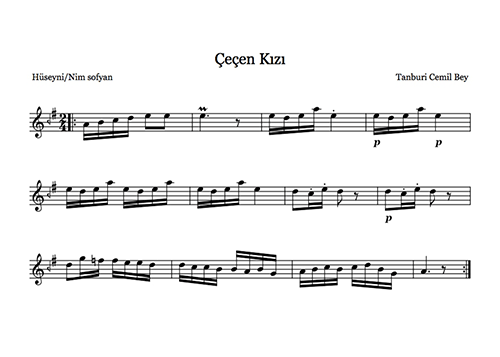
Video:
Vibration:
Vibrato is a sound vibration technique.
The Turkish equivalent of this word, which is synonymous with Vibrato, is Vibration.
It is used in the sentence, such as "vibrato in the Ney instrument" or "vibration in the Ney".
As with most instruments, vibration or vibrato sound is related to the special work of the instrumentalist.
(Vibration is not performed on instruments such as harp, piano etc.)
What, as you will see in the video, vibrations are in four different forms:
1 - Vibrations made by shaking our (Kaval style)
2 - Vibrations made by turning our head to the right and left (style of Arabic Nayi's)
3-Vibration made by turning our head up and down.
4 - Vibration from the side (Niyazi Say�n style)
The vibrato technique that we have taken as a base is the vibration made with the side of Niyazi Say�n's school.
It is necessary to do a special work for this vibrational style which is most effective.
Dear Neyzens;
We finished the ney instrument lessons
I will try to update the videos from this day onwards.
I will try to add new works, new video narrations, new authorities.
If you have any problems in the lessons, you can send e-mail from me to try to help.
If you do not understand the points, you can communicate with me.
My purpose in preparing the Ney lessons is to teach the lessons,
to help ney enthusiasts who are not educated in conservatories.
In addition, on the internet, Ney is trying to identify the breed, where Ney courses or
To help friends who can not find Ney communities.
Of course, there may be criticism topics you do not like or information and shares you want to share.
You can contact me for this too.
I am open to your suggestions, your opinions, your criticisms.
I will try to add new works, new video narrations, new authorities.
If you have problems you can email me.
My aim in preparing the ney lessons, especially those who do not take private lessons,
is to help Ney enthusiasts who do not have a conservatory education.
Of course, there may be an opinion you do not like or the information and shares you want to share.
You can also contact me for this.
Your suggestions, opinions and criticisms are important to me.
I wish you all good work.
Keep your breath strong :)
www.neyzenim.com Neyzen Zeki Sözen
|