Ney Lessons
Ney Lessons - 5 -
Concepts
of Nature and Diyez in Turkish Music
In this lesson, let's take a look at the issue
of Sharp and see the curves of La, Do Sharp.
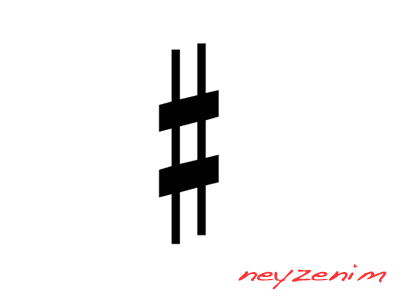
Sharp; It is the sign that raises or shines
the sound that comes in front of you half way.
Sharp Mark
The order of the dash marks is:
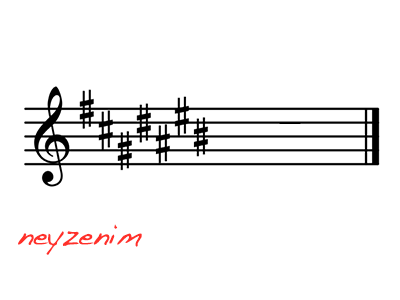
Sharp sign was first used in 1300.
Sharp signs used in Turkish music:
| Aral���n Ad� |
Koma De�eri |
Diyez ��areti |
Sembolü |
| Koma |
1 |
 |
F |
| Bakiye |
4 |
 |
B |
| Küçük Mücennep |
5 |
 |
S |
| Büyük Mücennep |
8 |
 |
K |
| Tanini |
9 |
 |
T |
| Art�k �kili |
12-13 |
- |
A |
| ney dersleri |
|
|
neyzenim.com |

Meanwhile, irrespective of the subject,
you can see the concept of "coma as value" in the table above.
Coma: A complete voice is a small interval
equal to one in nine.
We will talk more about our future courses
in coma.
Bekar (Naturel) Note:
Single (Naturel) is a sign that indicates
that the sounds in the hardware or on the note that have sharp and
flat defects will turn into natural sounds (do,
re, mi, etc.).
Naturel Note:

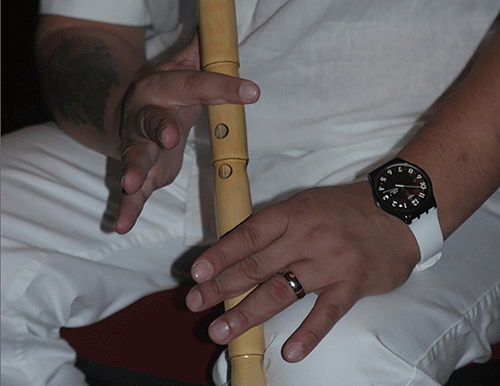
DO SHARP NOTE
Klasik T�rk M�zi�inde bu perdenin ismi N�M
H�CAZ hole.
We will close Curtains:
RIGHT HAND: Head and Toe Fingers.
LEFT EL: Middle Fingers.
Review the picture below:
Movies :
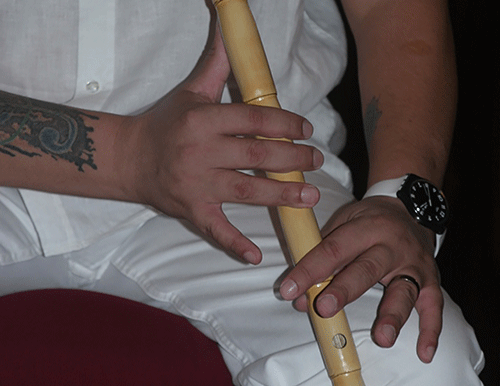
LA SHARP NOTE
Klasik T�rk M�zi�inde bu perdenin ismi K�RD�
hole.
We will close Curtains:
RIGHT HAND: Head Finger, Sign Finger, Middle
Finger and Ring Finger.
LEFT HAND: Our Sign Fingers.
Review the picture below:
Movies :
1 note Study
Metronom: 80

Movies:
faster:
2 Crocet Study:
Metronom: 80

Movies:
More Faster:

Videomuz:
Eight one Note
Metronom: 80
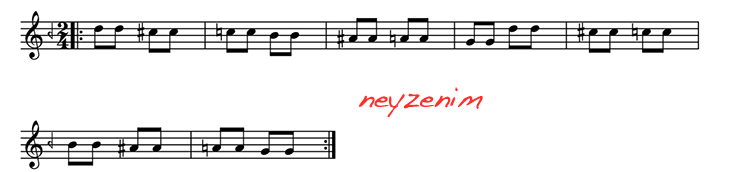
Movies:
Examples :
Metronom: 80

Videomuz:
Important Note: La peaks and Si peaks are
the same.
In the following example, we will play in
the same position as La pseudo-arc, let's take a look at the Si flat
work.
Metronom: 80
In this work, we can breathe through the
note we want because there is no comma sign.

Movies :
Note: If the pitch and flat sign is equipped,
all parts are played with sharp and flat.
If it is specified in any dimension, it
is valid only for that dimension.
We must have finished the following steps
to pass the other lesson:
We have completed our position and now we
know our Ney blowing position.
-We are starting to extract the left voice
or we can blow this sound long.
We know by heart what positions are punched
in -Re, #Do, Do, Si, #La, La and Left curtains.
We have also memorized the number of notes,
the double note,
the 1 note note and the octave note value, and how
many note marks it is.
After completing these steps, we can begin
our 6th lesson.

www.neyzenim.com Neyzen Zeki Sözen |