Ney Lessons - 7 -
Mid Sound Exercises and Fermata
In our seventh lesson, we present you our exercises on medium curtains.
Here is the exercise we will work first:
Re Note Study:
Metronome: 80

Videomuz:
We can blow the same notes from different positions:
As you will see in this video, we will blow Re curtain with all curtains closed.
After blowing the sounds correctly, whichever position you are comfortable in, blow in that way.
It will be very helpful for us to study these exercises until we memorize them, not just once, but even several times.
Let's play slow-paced, fast, faster and even faster, and let's blow the sounds without looking at the notes anymore.

Do note work :
Metronom: 80

Si note work :
Metronom: 80

La note work :
Metronom: 80

Sol note work :
Metronom: 80

Fermatas
Fermata: It is a sign that a human or instrumental
voice is interrupted for a short or long time.
It is also a matter of reading the note,
of course.
When we are reading a note, whichever way
we count the note values, we read it by counting it in the same
way.
Unity Fermata, Double Fermata, One Fermata,
Eight Fermata, Hex Fermata, Sixty Fermata, there are.
There are seven signs Fematas.
Semibreve Rest:
The mark on the bottom of the 4th line of the screen
and the value is four strokes.
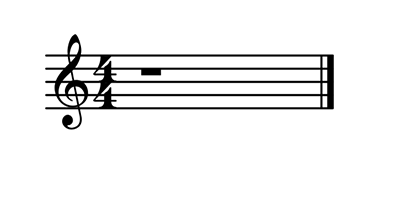
Tiny exercise:
Metronom: 80

Movie:
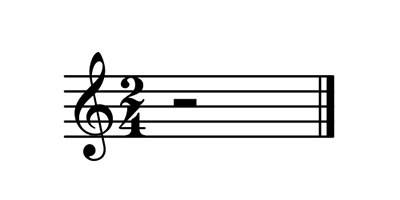
Minik alıştırma :
Metronom: 80

Video:
1 Crochet Rest:
This sign, as seen, is the sign written between the 2nd line and the 4th line.
Its value is up to a quarter note.
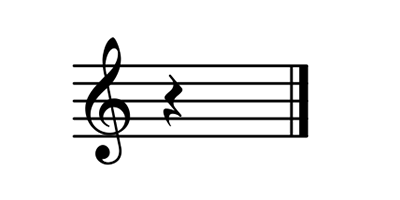
Tiny exercise:
Metronom: 80

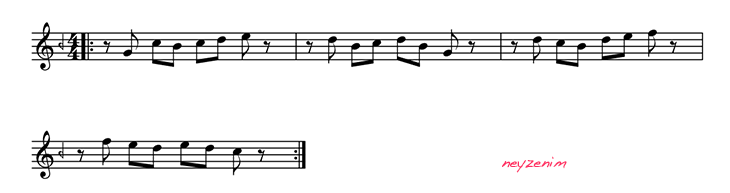
Quaver Rest :
This escape sign with a value of 1 octet is written between line 2 and line 4.
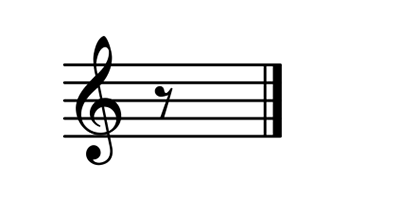
Tiny exercise:
Metronom: 90
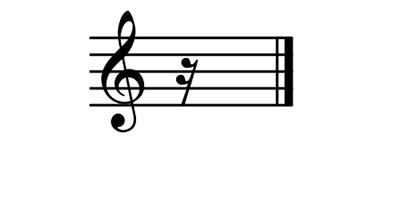
Semi-Quaver Rest :
To the 3rd interval of the end port in the hooks,
The second one is written in the 2nd range and the tail is extended to the 1st line of the port.
Its value is up to a 1/16 note.
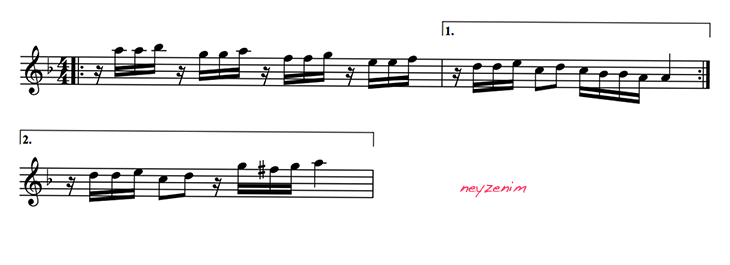
Tiny exercise:
Metronom: 80
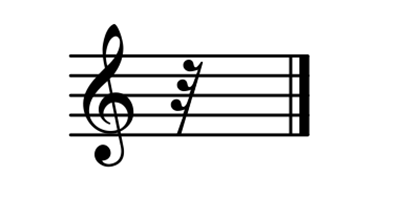
Triple Croche Rest :
The topmost tip in the value hooks is written in the 1st interval of the port,
the 2nd in the 2nd interval, and the 3rd in the third interval.
As you can see in the picture, the tail is extended to the 1st line.
Its value is up to 1 / 32th note.
Turkish music has never used
Altm��d�rtl�k (1/64) Sus ��areti :
The topmost tip in the value hooks is written on the 1st interval of the port,
the 2nd on the 2nd interval, the 3rd on the 3rd interval, and the 4th on the 4th interval.
As you can see in the picture, the tail is extended to the bottom of the 1st line.
Its value is up to 1/64 note.
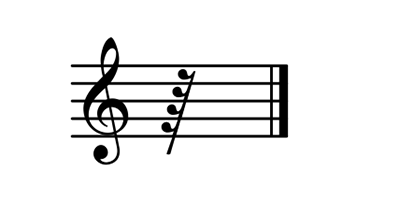
Turkish music has never used
Our Objectives at The End Of This Lesson:
- We know all the notes from the Rast curtain to the Muhayyer curtain.
- We are at a level to memorize the exercises in our lesson,
we can blow them even without looking at the note.
- After completing our lesson, we move on to our other lesson.
- By blowing flat sound, we further strengthen the sound from our Ney.

www.neyzenim.com Neyzen Zeki Sözen |